
Process Serving Florida Gated Communities: GPS Guide
If you litigate civil cases in South Florida, you are intimately familiar with the unique geography of the region. It’s not just the sprawling suburbs or the high-rise condos; it’s the sheer density of gated communities.
Yasmin Morshedian
Founder & CEO, YM Legal Services
If you litigate civil cases in South Florida, you are intimately familiar with the unique geography of the region. It's not just the sprawling suburbs or the high-rise condos; it's the sheer density of gated communities.
Key Takeaways
- Florida Statute § 48.031(7) prohibits gated community security from arbitrarily denying access to a process server who presents valid identification and states their purpose.
- GPS-verified tracking provides timestamped, coordinate-logged proof of every service attempt—critical evidence for motions for substituted service.
- Proper documentation of denied access (time, date, guard identity, reason) builds the foundation for alternative service methods.
- Licensed, bonded process servers trained in Florida statutory requirements avoid the costly mistakes of generic couriers.
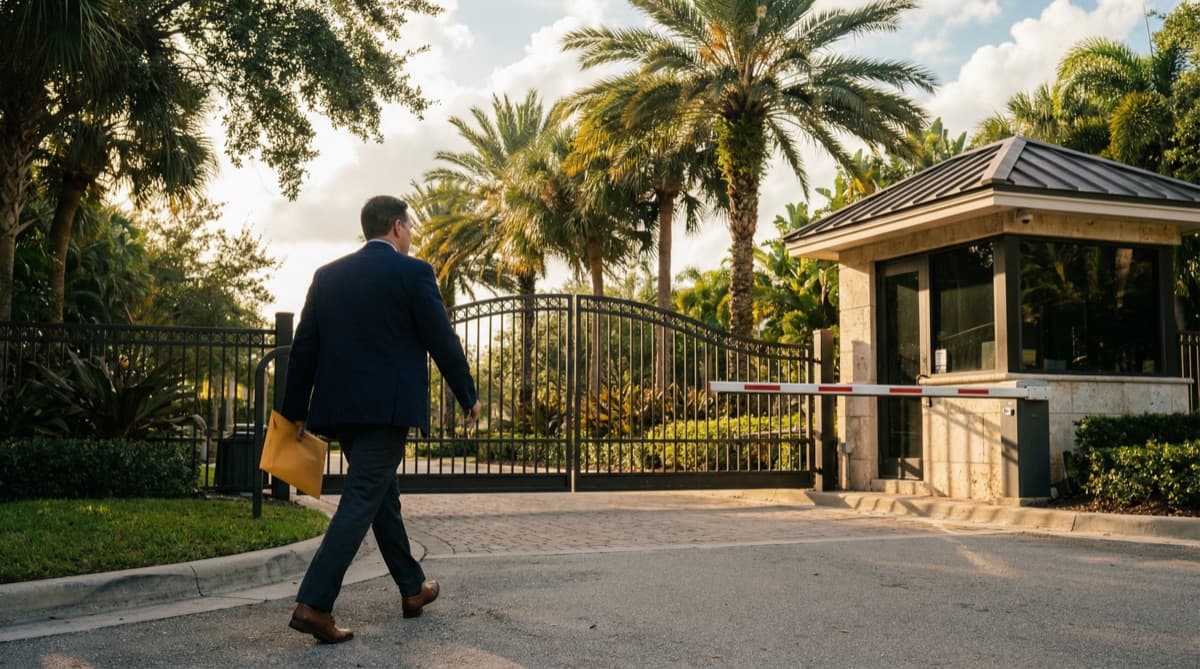
From Boca Raton down to Pinecrest, the "Florida Room" and the security guard gate are standard features of the landscape. For a process server, these communities are often the single biggest obstacle to effectuating service.
When I was a paralegal managing high-volume litigation dockets, the most frustrating update I could receive from a vendor was a simple, unhelpful status report: "Access denied at gate." It meant the clock on the 120-day service window was ticking, the defendant was likely evading, and the firm was bleeding money on unproductive attempts.
That frustration was one of the driving forces behind the process serving division at YM Legal Services. We didn't want to just be another vendor making blind attempts at a fortified address. We wanted to provide law firms with a strategic advantage in a notoriously difficult environment.
Here is the reality of serving process in Florida's gated communities, and how YM Legal utilizes technology and legal compliance to break through the barriers.
The Legal Framework for Gated Community Service
The fundamental legal challenge is that a process server cannot simply trespass. Florida law requires that service be effectuated legally, which means the server must gain lawful access to the defendant's residence or place of business. In a gated community, that access is entirely controlled by a private security guard or an automated entry system.
Historically, evasive defendants would simply instruct the guard gate to deny entry to anyone they didn't explicitly authorize. This created a massive loophole, allowing defendants to essentially hide in plain sight while the plaintiff's timeline expired.
However, Florida law has evolved to address this specific tactic. Florida Statute § 48.031(7) provides a critical mechanism for process servers facing uncooperative security personnel. The statute explicitly states that an unsworn security guard or an automated system cannot arbitrarily deny access to a process server who presents valid identification and states their purpose. If the guard refuses entry, the server can, under specific conditions, effectuate substituted service on the guard or the manager of the community.
But invoking this statute requires a process server who understands the nuances of the law and is prepared to document the encounter flawlessly. A generic courier or an inexperienced server will often simply turn around at the first "no."
Citation Capsule: Florida Statute § 48.031, as currently codified, provides explicit protections for licensed process servers attempting service in gated residential communities—a statutory framework that many generic courier services fail to invoke because they lack the training to document a denial properly (Florida Statute § 48.031 — Service of Process).
How YM Legal Navigates Gated Communities
At YM Legal Services, our process servers are licensed, bonded, and deeply experienced in navigating the complexities of Florida Statute § 48.031(7). They don't just attempt service; they build a legally sound record of every interaction at the gate. If a guard denies access, our servers document the time, the date, the identity of the guard (if provided), and the specific reason given for the denial.
This level of documentation is critical if you need to file a motion for substituted service or defend the validity of the service against a motion to quash.
Citation Capsule: The 11th Judicial Circuit's Certified Civil Process Server Program Manual requires licensed servers to maintain detailed records of every attempt—including date, time, location, and the identity of any person who obstructs access—documentation standards that directly support the evidentiary record needed for alternative service motions (11th Judicial Circuit — Certified Civil Process Server Program Manual (2024)).
But documentation is only half the battle. The other half is verifiable proof of the attempt.
GPS-Verified Tracking for Every Service Attempt
This is where YM Legal's technological infrastructure sets us apart from the traditional "guy with a clipboard" model. We utilize advanced, GPS-verified tracking for every single service attempt.
When our server approaches a gated community in Weston or a high-rise in Brickell, their location is logged via GPS coordinates and timestamped. If they are denied entry, that denial is instantly recorded in our system, along with the GPS data proving they were physically present at the correct address at the stated time.
This data is then immediately available to our clients through real-time status updates. You don't have to wait for a weekly report or chase down a vendor for an update. You know exactly when the attempt was made, where the server was located, and the specific outcome of the interaction.
When you partner with YM Legal Services for process serving, you aren't just hiring a courier. You are deploying a legally savvy, technologically equipped professional who understands how to navigate the physical and legal barriers of South Florida. When the gate won't open, you need a server who knows exactly what to do next. Contact us or call (954) 334-1092.
Related Reading: What Is Court Reporting? A Complete Guide | 24/7 After-Hours Litigation Support | Scheduling a Court Reporter in South Florida
Frequently Asked Questions
Can a process server enter a gated community in Florida?
Yes. Under Florida Statute § 48.031(7), a gated community's security guard or automated system cannot arbitrarily deny access to a process server who presents valid identification and states their purpose. If access is denied despite following proper procedure, the server may pursue substituted service on the guard or community manager under certain conditions.
What does Florida Statute 48.031(7) say about gated communities?
The statute provides that when a process server is denied access to a gated residential community after presenting valid identification and stating their purpose, the server may effectuate substituted service on the community's security guard or manager. The server must properly document the denial and follow specific statutory procedures.
How does GPS tracking help with process serving?
GPS-verified tracking creates a timestamped, coordinate-logged record of every service attempt. This data proves the server was physically present at the correct address at the stated time. If a defendant later challenges service, this GPS evidence supports the validity of the attempt and is critical for motions for substituted service.
What happens if a gated community refuses entry to a process server?
A licensed process server trained in Florida law will document the denial—recording the time, date, guard identity (if given), and specific reason for refusal. This documentation forms the basis for filing a motion for substituted service. An inexperienced server who simply leaves after the first refusal wastes time and money while the plaintiff's 120-day service window continues ticking.