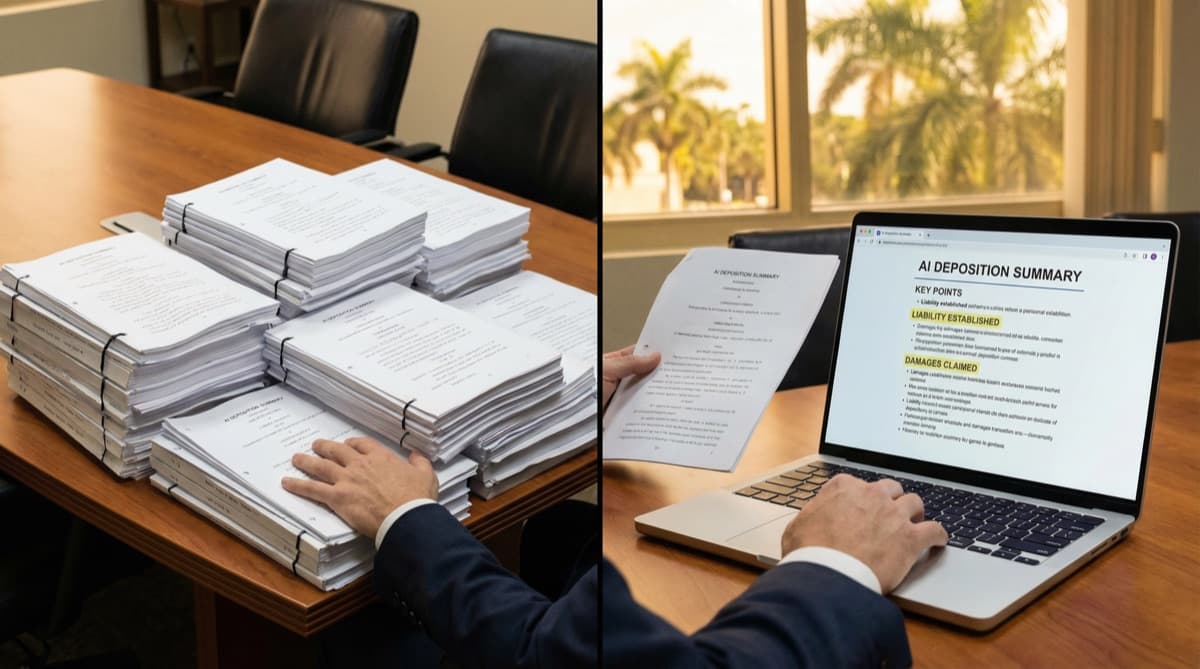
How AI Is Transforming Deposition Transcript Summaries
AI transcript summarization is changing how attorneys review depositions. This guide covers how AI summaries work, accuracy rates, and when they add the most value to case preparation.

Yasmin Morshedian
Founder & CEO, YM Legal Services
AI-powered tools can now summarize a 100-page deposition transcript in roughly three minutes (Dodonai, 2025). That speed matters because the legal AI market grew from $4.59 billion to $5.59 billion in a single year, reflecting a 22.3% compound annual growth rate (Research and Markets, 2025). Attorneys who once spent entire afternoons reading transcripts line by line are finding that AI summaries give them a reliable first pass, freeing time for the analysis and strategy that actually win cases.
This guide explains how AI deposition summarization works, where it excels, where it falls short, and how to decide whether it belongs in your workflow. Learn more about our AI transcript summary service.
Yasmin Morshedian founded YM Legal Services in 2018 and oversees both traditional court reporting and AI-assisted transcript services. Her agency has processed thousands of deposition transcripts and was an early adopter of AI summarization tools for Florida litigation support.
Key Takeaways
- AI can summarize a 100-page deposition transcript in about 3 minutes, versus 2-4 hours manually
- Law firm AI adoption jumped from 19% to 79% between 2023 and 2024 (Clio via ABA Journal, 2024)
- AI summaries work best as a first-pass tool, not a replacement for attorney review
- Accuracy depends on transcript quality, speaker identification, and legal context
What Are AI Transcript Summaries?
AI transcript summaries use natural language processing to condense lengthy deposition transcripts into structured digests. Law firm AI adoption surged from 19% to 79% between 2023 and 2024 (Clio via ABA Journal, 2024), and transcript summarization is one of the most practical applications driving that shift.
How They Differ from Traditional Digesting
Traditional deposition digesting requires a paralegal or attorney to read every page, tag key testimony, and write page-line summaries. That process typically takes two to four hours for a 100-page transcript. AI summaries compress that timeline to minutes.
The output usually includes a condensed narrative, a topic-by-topic breakdown, key admissions flagged by relevance, and page-line citations tied to the original transcript. Some tools also generate witness profiles and contradiction alerts automatically.
What the Output Looks Like
Most AI summarization tools produce three deliverables: a high-level overview (one to two paragraphs), a detailed topic index with page-line references, and a searchable database of testimony excerpts. The format varies by platform, but the core purpose is the same. Give the attorney a structured starting point so they can focus review time on the testimony that matters most.
How Does AI Deposition Summarization Work?
Modern AI summarization tools process transcripts through multiple stages, each building on the last. The legal AI market's 22.3% CAGR (Research and Markets, 2025) reflects rapid improvement in these underlying technologies, particularly in how models handle legal terminology and multi-speaker documents.
Stage 1: Preprocessing
The tool first parses the raw transcript file (usually ASCII or PDF). It identifies speaker labels, page-line numbers, and colloquy markers like "Q:" and "A:". Formatting inconsistencies, such as split words across line breaks, are normalized during this step.
Stage 2: Segmentation and Topic Detection
Next, the AI groups testimony into topical clusters. It recognizes when the questioning shifts from employment history to the incident at issue, for example. This segmentation powers the topic index that most attorneys find most useful.
Stage 3: Extraction and Summarization
The model then extracts key statements, admissions, and denials from each segment. It generates summaries at multiple levels of detail, from a one-paragraph overview down to verbatim excerpts with citations. Better tools distinguish between a witness's direct testimony and attorney colloquy or objections.
Stage 4: Quality Scoring
Some platforms assign confidence scores to each summary section. Lower scores indicate areas where the AI found ambiguous testimony, overlapping speakers, or unclear references. These flags help attorneys know exactly where to focus manual review.
How Accurate Are AI Deposition Summaries?
Accuracy is the question every attorney asks first, and it deserves a direct answer. Current AI summarization tools produce factually reliable summaries roughly 85-95% of the time, according to vendor benchmarks and independent testing by firms piloting these tools. The remaining 5-15% typically involves misattributed speakers, missed nuance, or oversimplified legal context.
In practice, accuracy depends heavily on three factors: transcript quality, speaker count, and subject matter complexity.
Where AI Excels
AI is very good at identifying factual admissions, dates, names, and numerical testimony. It handles single-witness depositions with clean transcription reliably. It's also consistent. Unlike a fatigued paralegal on page 87, the AI applies the same attention to the last page as the first.
Where AI Struggles
Multi-party depositions with frequent objections and sidebar colloquy can confuse speaker attribution. Sarcasm, hedging, and qualified answers ("I believe so, but I'm not entirely sure") sometimes get summarized without the qualification. Technical or domain-specific testimony, such as medical or engineering depositions, may also lose precision if the model wasn't trained on that vocabulary.
The Bottom Line on Accuracy
No responsible legal professional should treat an AI summary as a final work product. It's a first draft. But as a first draft, it's remarkably useful. The time saved on initial review can be redirected to the interpretive work that requires a legal education.
When Do AI Summaries Add the Most Value?
AI transcript summaries deliver the highest return in high-volume litigation. A firm handling 20 depositions in a single case can save hundreds of hours by running AI summaries first, then assigning attorneys to review only the flagged sections (Dodonai, 2025). A 100-page transcript summarized in three minutes versus three hours is a meaningful difference when multiplied across a full docket.
High-Volume Cases
Mass tort, class action, and multi-district litigation generate enormous transcript volumes. AI summaries let teams triage depositions quickly, identifying the five transcripts that need deep analysis out of fifty.
Early Case Assessment
During the early stages of litigation, attorneys often need a broad understanding of deposition testimony before developing case strategy. AI summaries provide that overview without committing associate hours to full digests that may not be needed.
Witness Preparation
When preparing a witness for trial, attorneys sometimes review depositions from related witnesses. AI summaries of those peripheral depositions save time without sacrificing the key factual picture.
There's a less obvious use case worth noting: contradiction detection. Some AI tools can cross-reference a witness's deposition against prior statements, interrogatory answers, or other witnesses' testimony. That capability turns the summary from a passive digest into an active case-building tool.
AI summaries pair especially well with remote depositions, where attorneys may not have been physically present with the witness. And for depositions captured on video, combining an AI summary with legal videography creates a powerful trial preparation package.
How Do AI Summaries Compare to Traditional Digesting?
The legal AI market's growth to $5.59 billion (Research and Markets, 2025) hasn't eliminated traditional digesting, and it shouldn't. Each approach has strengths. The practical question is when to use which.
Speed
AI wins decisively. Three minutes versus two to four hours for a 100-page transcript. For a 300-page transcript, the gap widens further.
Cost
Traditional digesting by a paralegal or contract attorney typically costs $150-$400 per transcript, depending on length and complexity. AI summarization tools range from $15-$75 per transcript, though pricing models vary (per page, per transcript, or subscription).
Nuance and Context
Traditional digesting wins here. An experienced paralegal understands case theory and can flag testimony that's strategically important even if it doesn't contain obvious keywords. AI doesn't know your case theory. It doesn't understand that a witness's hesitation on a seemingly minor point could be the crux of your motion for summary judgment.
The Hybrid Approach
What's working best for most firms is a hybrid model. Run the AI summary first. Use it to identify sections requiring deeper review. Then have a human reviewer focus on those sections with full case context. At YM Legal Services, this is the approach we've seen deliver the strongest results for attorneys who want both speed and precision. Our court reporting services produce the certified transcripts that feed directly into our AI summarization workflow.
Citation Capsule: The legal AI market reached $5.59 billion in 2025, growing at a 22.3% compound annual rate, with transcript summarization and document review representing the highest-adoption use cases among litigation-focused firms (Research and Markets — Legal AI Market Report).
How Can You Get Started with AI Transcript Summaries?
Getting started doesn't require a six-figure technology investment. With 79% of law firms now using AI tools in some capacity (Clio via ABA Journal, 2024), the barrier to entry has dropped significantly. Most attorneys can pilot AI transcript summaries within a week.
Citation Capsule: Law firm AI adoption surged from 19% to 79% between 2023 and 2024, driven largely by practical tools like transcript summarization and document review—not speculative applications—confirming that AI deposition summaries have moved from early-adopter territory into mainstream litigation practice (ABA Journal — AI Adoption in Law Firms).
Option 1: Self-Service Platforms
Several platforms let attorneys upload transcripts directly and receive summaries within minutes. These tools typically charge per page or per transcript and require minimal setup. They work well for solo practitioners and small firms that want to experiment before committing.
Option 2: Legal Service Providers
Firms that prefer a managed approach can work with legal service providers who combine AI summarization with human review. YM Legal Services, for example, offers AI-assisted transcript summaries that include a quality review layer, so attorneys receive a polished work product rather than raw AI output.
Attorneys we work with typically report a 60-70% reduction in initial transcript review time when using AI-assisted summaries compared to fully manual digesting.
Option 3: In-House Deployment
Larger firms with dedicated legal technology teams can deploy AI summarization models in-house. This approach offers greater control over data security and customization but requires meaningful upfront investment in infrastructure and training.
Evaluating Any Tool
Before committing to a platform or provider, ask these questions: Does it preserve page-line citations? Can it handle multi-speaker transcripts? What's the error rate on speaker attribution? Does it flag low-confidence sections? And critically, where does your transcript data go after processing?
Frequently Asked Questions
Can AI fully replace human deposition summarizers?
Not yet. AI produces strong first-pass summaries, but it lacks case-specific context and strategic judgment. The best results come from a hybrid workflow where AI handles the initial summary and a human reviewer adds case context, verifies accuracy, and flags strategically important testimony. Think of AI as a highly efficient first reader, not a replacement for legal analysis.
How long does an AI deposition summary take?
Most AI tools can process a 100-page deposition transcript in approximately three minutes (Dodonai, 2025). Longer transcripts scale roughly linearly. A 300-page transcript typically takes under ten minutes. Traditional manual digesting of the same 100-page transcript takes two to four hours.
Is it safe to upload confidential deposition transcripts to AI tools?
Data security varies significantly by platform. Look for tools that offer end-to-end encryption, SOC 2 compliance, and clear data retention policies. Some platforms delete transcript data after processing, while others retain it to train models. Always read the terms of service and consult your firm's ethics and compliance team before uploading client materials.
What types of cases benefit most from AI transcript summaries?
High-volume litigation, including mass tort, class actions, and multi-district litigation, sees the greatest return. Cases involving 10 or more depositions benefit from the speed and consistency of AI summarization. But even single-deposition cases can benefit when attorney time is at a premium. The key factor is whether the time savings justifies the cost of the tool.
Ready to try AI-powered transcript summaries? Contact YM Legal Services to learn about our AI-assisted summarization options.
Related Reading
- What Is Court Reporting? A Complete Guide -- understand the foundation of transcript production
- Remote Depositions in Florida: Everything Attorneys Need to Know -- AI summaries pair well with remote deposition workflows
- Court Reporter vs. Digital Recording -- how recording method affects transcript quality for AI processing
- The Future of Litigation Support in Florida -- where AI and court reporting technology are headed